Practice
A spoken mock interview that listens and asks the follow-up
What it does
Practice runs a spoken mock interview against a job and one of your resumes, asking follow-up questions based on what you actually answer. It works with or without a briefing, and with or without a posting.
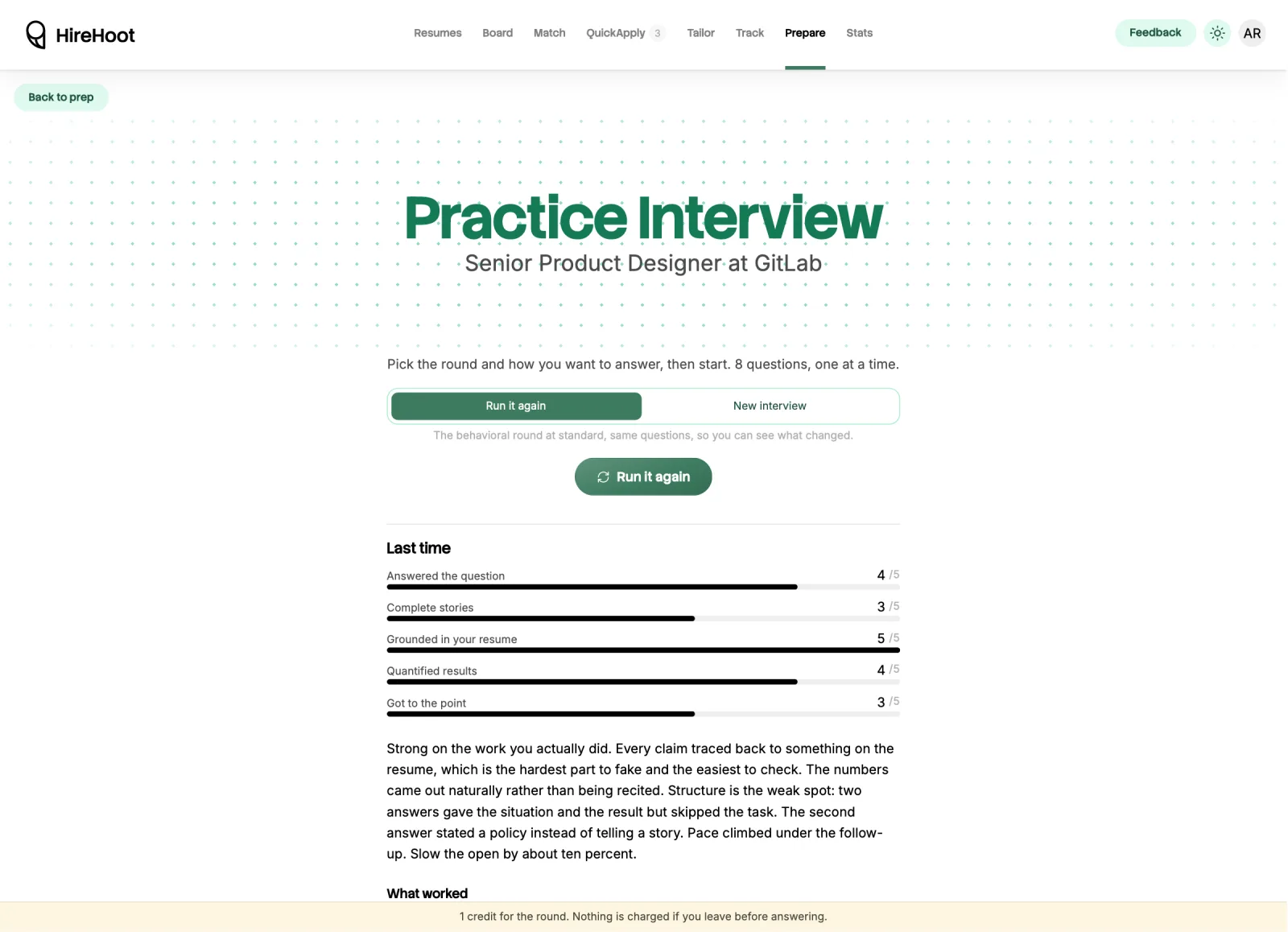
It grades the session against the resume you paired with that job and returns a scorecard with a note on each answer.
When to use it
- You have read the briefing and want to rehearse before the real thing.
- You keep freezing on the same question and want to run it a few times.
How to use it
-
Pick a job and a resume
A briefing is not required, so you can go straight into a round. Building one first is still worth it: the interviewer reads it, steps around the questions you already have an answer ready for, and aims at the gaps it found instead.
-
Pick the round
Recruiter screen, hiring manager, craft or final round. That is the only choice to make: rounds are spoken, and the interviewer pushes back on anything vague.
-
Run the session
Answer each question as you would in the real thing. Follow-ups come from your answers. Starting a session is what spends the credit.
-
Read the scorecard
You get an overall score, what worked, what to fix, and a critique of each individual answer with your pace and filler count.
-
Run it again
Repeat rounds against the same briefing are how this gets useful. Each round is another credit.
What it costs
One credit per session. Taken when the round starts and refunded in full if you leave before answering anything, so opening a round to look at it costs nothing. Reviewing a finished session afterwards is free.
How credits workGood to know
Each round costs a credit
Three practice rounds against one briefing is three credits. The briefing itself was a separate one.
Backing out is free
The credit is taken when the round starts, but a round you leave before answering a single question is refunded in full. Once you have answered something, it counts.
You need a microphone and somewhere to talk
Rounds are spoken, so your browser will ask for microphone permission and you have to be somewhere you can answer out loud. There is no typed mode.
A good score is not a prediction
It measures this rehearsal against your own application. It cannot tell you what a particular interviewer will think of you.